
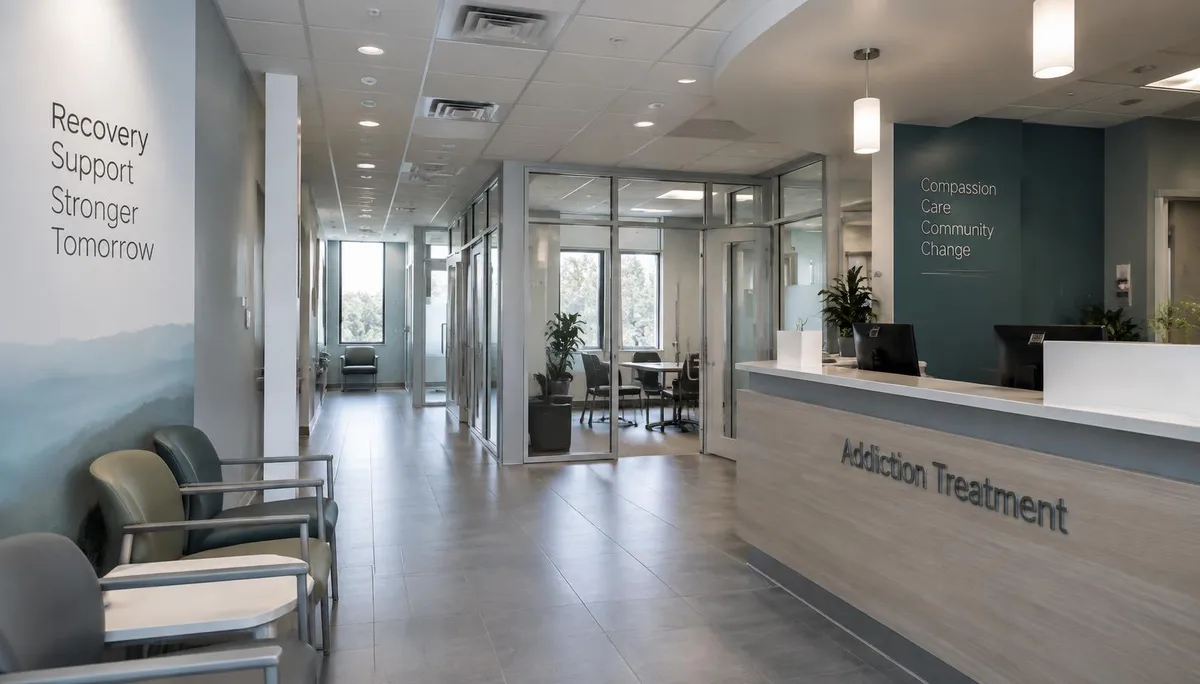
Find Drug Rehab Centers Near You

Medically Reviewed By
Substance use treatment spans a wide range of settings, and figuring out what's actually available — and what fits a specific situation — can be the hardest part of getting started.
This page walks through the main levels of care, how to actually research and compare facilities, the common decision points people run into, and what's worth confirming before choosing a program. A licensed healthcare professional is best positioned to help determine an appropriate level of care for a specific situation.
What is drug rehab?
Drug rehab is a broad term covering structured treatment for substance use disorder, spanning several distinct levels of care rather than referring to one single kind of program. The goal of most treatment is to address the thoughts and behaviors associated with substance use and, where needed, manage physical dependence — and many people benefit from more than one type of treatment over time, moving between levels of care as their needs change.
Different levels of substance use treatment and how they differ
Treatment isn't one service. These are the settings you're generally choosing between.
- Detoxification addresses withdrawal specifically and is usually the shortest phase of treatment, when it's needed at all.
- Inpatient or residential treatment provides round-the-clock structured care in a live-in setting, generally considered when someone needs a higher level of support than outpatient care provides.
- Outpatient treatment allows someone to continue living at home while attending scheduled sessions, ranging widely in intensity from a single weekly session to a more intensive daily program.
- Medication-based treatment is used for certain substances as part of a broader treatment plan, sometimes on an ongoing, long-term basis, and is generally available alongside other levels of care rather than as a standalone option.
- Ongoing counseling and recovery support may continue for months or years after a more intensive program ends.
Understanding which of these settings a specific facility actually offers — and whether it can help someone move between them as needs change — is one of the most useful things to clarify early in a search, since not every facility offers the full continuum.
How long drug rehab programs typically run
Program lengths are commonly described in 28 or 30 day, 60 day, and 90 day blocks. Those numbers describe how a program is scheduled and billed rather than a clinical category. Length of stay for an individual is generally set through a clinical assessment and reassessed as treatment progresses.
- Detoxification. Where withdrawal management is needed, that phase is generally described in days and is separate from the treatment program that may follow.
- 28 to 30 days. The most commonly offered residential block, and the length most frequently referenced in insurance benefit structures.
- 60 to 90 days and longer. Extended programs. Federal treatment guidance has historically noted that participation of roughly three months or more is associated with better retention in research, though that is a population-level finding rather than a prediction about any individual.
- Outpatient and medication-based treatment. Outpatient schedules are measured in weeks or months of scheduled hours, and medication-based treatment for some substances is described in federal guidance as potentially long-term rather than time-limited.
Length of stay and payer coverage are separate questions. A facility may describe a 90 day program while a specific plan authorizes a shorter initial period subject to continued review. Those authorization details are plan-specific and come from the insurer.
What drug rehab costs, and what drives the price
There is no standard national price for substance use treatment. Published figures describe different things — the amount a facility bills, the amount an insurer pays, and the amount a person pays out of pocket are three separate numbers. What drives cost is more useful than a single average.
- Level of care. Outpatient counseling, intensive outpatient programming, partial hospitalization, and residential or inpatient care sit at very different price points.
- Level of medical oversight. Physician coverage, around-the-clock nursing, and hospital affiliation carry higher operating costs than a lighter clinical staffing model.
- Length of stay or program. Residential care is generally priced daily and outpatient care by session or week, so duration is a direct multiplier in both.
- Services included in the rate. Detoxification, psychiatric care, medication, lab work, and specialized therapies are bundled at some facilities and billed separately at others.
- Funding type and amenities. Publicly funded, non-profit, and private facilities operate on different pricing structures, and private rooms and resort-style settings carry costs unrelated to clinical intensity.
Payment structures facilities commonly report include private insurance, Medicaid, Medicare, military insurance, cash or self-pay, sliding fee scales based on income, and payment assistance. SAMHSA's facility data records which of these each facility reports accepting. Reported acceptance is not the same as confirmed coverage — specific figures come from the facility and the insurer.
How insurance generally applies to substance use treatment
Federal parity law generally requires group health plans and most marketplace plans covering substance use treatment to apply financial requirements and treatment limits no more restrictively than for comparable medical and surgical care. That sets a baseline; it does not mean every plan covers every facility or every level of care.
- In-network versus out-of-network. Contracted facilities are billed at negotiated rates, while out-of-network care is generally covered at a lower rate or not at all, depending on the plan.
- Prior authorization. Many plans require approval before an inpatient or residential admission, based on documentation from a clinical assessment.
- Medical necessity review. Plans commonly evaluate whether the requested level of care is clinically indicated, frequently referencing criteria such as the ASAM Criteria.
- Continued-stay review. Authorization is often granted for an initial period and extended based on ongoing clinical documentation.
- Medication coverage. Medications used in treatment for some substances are covered under the pharmacy or medical benefit depending on the plan, and formulary placement varies.
- Medicaid. Substance use benefits are administered state by state, so covered levels of care and participating facilities differ considerably between states.
Denials are not always final. Plans are generally required to provide a reason for a denial and an appeals process, with both internal appeals and external review typically available. The specifics are set out in plan documents.
What admission to a treatment program generally involves
Admission processes differ by facility, but most follow a broadly similar sequence.
- Initial phone assessment. A screening conversation covering substance use history, medical and psychiatric history, current medications, and insurance or payment information.
- Verification and authorization. The facility checks benefits and, where required, seeks authorization from the plan before an admission date is confirmed.
- Availability. Admission timing depends on current openings for the recommended level of care, and some facilities maintain waitlists.
- Intake day. Typically includes a clinical assessment, medical screening and vital signs, a medication review, an inventory of belongings against the facility's policy, consent paperwork, and orientation to the schedule.
- Early treatment days. Many residential programs describe a limited initial period with restricted phone or visitor contact. Policies vary widely and are set by each facility.
Dual diagnosis and co-occurring mental health conditions
Substance use disorders and mental health conditions frequently occur together, and SAMHSA describes treating both conditions together rather than sequentially as the approach reflected in federal treatment guidance.
In practice, that capability depends on what staffing a facility has on site: whether a psychiatrist or psychiatric nurse practitioner is available, whether psychiatric medication can be prescribed and adjusted during the program, and whether therapeutic programming addresses both conditions together. Programs describing themselves as dual diagnosis or co-occurring capable vary in how much of that infrastructure they actually have, which is why the specific staffing question tends to be more informative than the label.
Talk to someone now
- 100% Confidential
- No Obligation
Find Drug Rehab Centers Near You
Search our nationwide database by state, city, or ZIP.
How to find and compare drug rehab centers near you
The differences that matter usually aren't visible on a website.
- Verify licensing directly. Check with your state's health or behavioral health licensing department rather than relying solely on a facility's own materials.
- Ask about specific experience with the substance involved. Facilities vary in their depth of experience with different substances. A facility's experience with one substance does not necessarily indicate the same depth of experience with another. Asking directly about a facility's specific experience with the substance relevant to your situation is more informative than a general inquiry about their program.
- Understand what level of care actually means at a specific facility. Terms like “intensive outpatient” or “partial hospitalization” don't have perfectly standardized definitions across the industry, so it's worth asking a specific facility to describe exactly what a given level of care involves in terms of hours per week and services included, rather than assuming based on the label.
- Compare more than one facility. Facilities that look comparable online often reveal real differences in approach, staffing, and philosophy once you look into each one directly.
- Ask what a typical intake and assessment process looks like. Understanding how a facility gathers information before recommending a level of care — what a first conversation or assessment actually covers — gives a clearer sense of how thorough and individualized their process is, compared to a facility that seems to recommend the same program to everyone regardless of circumstances.
- Ask how a facility handles co-occurring mental health conditions. Since these frequently occur alongside substance use, understanding whether a facility treats both together or refers mental health care out separately is a meaningful practical difference.
- Treat accreditation as one additional factor. Accreditation from bodies like The Joint Commission or CARF reflects a facility meeting broader voluntary quality standards. Accreditation can be one additional factor to consider alongside licensing, staffing, services, and other program details.
What to compare when researching drug rehab centers
A short list of comparison points keeps the research concrete.
- Licensing and accreditation. Confirm state licensing independently and ask about any accreditation held.
- Specific substance experience. Ask about the facility's actual experience treating the substance relevant to your situation.
- Level of care definitions. Ask what a specific level of care actually involves at this facility, in concrete terms.
- Medication availability. If relevant to the substance involved, ask whether the program offers medication-based treatment and whether it can continue after the program ends.
- Co-occurring condition capability. Ask whether mental health conditions are treated alongside substance use or referred out separately.
- Aftercare planning. Ask what support is available after a program ends, and for how long.
- Current intake availability. Ask about current openings for this level of care.
- Approach to polysubstance use. Some facilities are equipped to address polysubstance use, while others may have narrower capabilities, so this is worth confirming directly.
- Intake and assessment process. Ask what a first assessment actually involves and how it informs the recommended level of care.
Questions to ask providers
Specific questions make an initial call considerably more useful than a general enquiry.
- What licensing and accreditation does this facility hold, and can you confirm the license number?
- What is your specific experience treating the substance involved in this situation?
- What does each level of care you offer actually involve, in terms of hours and services?
- Does the program offer medication-based treatment, if relevant, and can it continue long-term afterward?
- How does the facility address co-occurring mental health conditions?
- What does aftercare look like, and for how long does support typically continue?
- What is the facility's current intake availability?
- What payment options does the facility offer, and what payer participation does it currently report?
Common decision points during a drug rehab search
A few tradeoffs come up repeatedly during this kind of search.
- Choosing a generalist facility versus one with specific substance expertise. If a specific substance is involved, it's worth weighing a facility's general reputation against its actual documented experience with that particular substance, since treatment approaches and considerations can differ meaningfully by substance.
- Deciding how much weight to give medication-based treatment options. For some substances, whether a facility offers ongoing medication-based treatment can be a significant factor in the decision, particularly if that's part of what a healthcare provider has recommended. It's worth clarifying this specifically rather than assuming every facility offers the same medication options.
- Balancing insurance network status against clinical fit. A facility that seems like a strong fit isn't always in-network, and this is a genuine tradeoff worth discussing directly with both the facility and your insurer rather than deciding based on network status alone.
- Handling uncertainty about which level of care is actually needed. It's common to be unsure whether inpatient, outpatient, or something in between is the right starting point. A qualified healthcare professional can help assess which level of care may be appropriate, rather than trying to resolve this through research alone.
- Deciding what to do if insurance coverage falls short of expected cost. If your plan covers less than expected, it's worth asking the facility directly about payment plans, sliding-scale options, or other financial arrangements before ruling the facility out entirely.
- Weighing a single, longer program against a stepped sequence of shorter ones. Some people move directly into a longer residential or inpatient program, while others follow a sequence — detox, then a shorter inpatient stay, then outpatient support. Neither approach is universally better, and it's worth asking a facility how they think about sequencing levels of care for a situation like yours rather than assuming one program will necessarily be the whole answer.
- Deciding how to weigh a facility's specific therapeutic approach. Some programs are built heavily around a specific method — cognitive behavioral therapy, a 12-step framework, or another structured approach — while others blend several. If a specific approach has worked or not worked in the past, it's worth being direct with a new facility about that history rather than assuming any program will work equally well.
- Weighing a facility's stated experience against independently verifiable information. A facility's own description of its expertise with a specific substance is a reasonable starting point, but it's also worth asking specifically what services, staff training, or clinical protocols support that claim, rather than relying on the description alone.
Location and travel considerations
Some people prefer treatment close to home; others look elsewhere for a specific program, clinical specialization, or a genuine change of environment, particularly if a specific substance requires a level of specialized care not readily available locally.
If considering a facility at a distance, ask directly about transportation assistance, visiting policies for family, and how referrals for aftercare would work if you'd be returning to a different city once treatment ends.
Insurance and payment considerations
Payment options and payer participation vary by facility. Reported payer participation does not guarantee coverage for a specific plan. Coverage, network status, authorization requirements, deductibles, and copays vary by plan. Plan-specific information should be confirmed directly with the insurer and facility.
What to confirm directly with a facility
Before finalizing a decision, get specific answers on: current licensing status, actual experience with the specific substance involved, the facility's current payment options and reported payer participation, whether medication-based treatment is available, and what the plan is for aftercare once the program ends.
Frequently asked questions
What's the difference between drug rehab and detox?
Detox addresses the physical process of withdrawal and is typically shorter. Rehab is broader, encompassing ongoing therapeutic and behavioral treatment.
How do I find a facility with experience treating a specific substance?
Review the services a facility reports offering and ask directly about its experience treating the substance involved, including the clinical services and treatment approaches available.
Is medication part of drug rehab?
For some substances, medication is a recognized part of evidence-based treatment, sometimes continued long-term. Whether it's appropriate is a clinical decision.
How do I know what level of care is right?
A qualified healthcare professional can help assess which level of care may be appropriate for a specific situation.
Will my insurance cover drug rehab?
Coverage depends on the specific plan and provider. Confirming current, plan-specific details directly with your insurer is the most reliable way to understand your options.
What if the cost is higher than expected after insurance?
Ask the facility directly about payment plans or other financial arrangements before ruling out an otherwise strong option.
What if I'm not sure which substance-specific program is the right fit?
Reviewing the specific services and treatment approaches a facility reports offering, and asking directly about its experience with the substance involved, is more useful than relying on general marketing claims.
What if more than one substance is involved?
Some facilities are equipped to address polysubstance use, while others may have narrower capabilities, so this is worth confirming directly rather than assuming.
Does drug rehab work if someone doesn't feel ready?
This is a genuinely individual question best discussed with a healthcare professional or a facility directly, who can speak to how readiness is typically approached in their specific program.
How much does drug rehab cost?
There is no standard national price. Cost depends on the level of care, the amount of medical oversight provided, the length of the program, which services are bundled into the rate, and how the program is funded. The amount a facility bills, the amount an insurer pays, and the amount a person pays out of pocket are three different figures, and facility-specific numbers come from the facility and the insurer.
What is the difference between a 30, 60, and 90 day program?
These labels describe program length rather than a difference in clinical category. Programs are commonly organized around these durations for scheduling and billing reasons, while the appropriate length of stay for an individual is determined clinically and often reassessed during treatment.
Does insurance require approval before drug rehab starts?
Many plans require prior authorization for inpatient or residential treatment and review continued stay periodically using medical necessity criteria such as the ASAM Criteria. Requirements are plan-specific, and plans are generally required to provide a reason for a denial along with an appeals process.
What happens on the first day of drug rehab?
Admission days generally involve an intake assessment covering substance use and medical and psychiatric history, a medical screening, a review of current medications, an inventory of belongings against the facility's policy, consent paperwork, and orientation to the daily schedule. Specifics vary by facility.
Do drug rehab programs treat mental health conditions at the same time?
Some do and some do not. Programs treating substance use and a co-occurring mental health condition together are generally described as dual diagnosis or co-occurring disorder programs, and that capability depends on the psychiatric staffing a facility has on site.
Is Medicaid accepted at drug rehab facilities?
Participation varies by facility and by state, since Medicaid substance use benefits are administered at the state level. SAMHSA's facility data records which payment types each facility reports accepting, though reported participation is not the same as confirmed coverage for a specific plan.