
The Badge on the Website: What Treatment Center Accreditation Actually Means
Every treatment facility operating in the U.S. needs a state license just to open its doors. Licensing sets a legal floor — the minimum requirements a state considers necessary for a facility to operate at all, covering things like basic safety codes, staff qualifications, and record-keeping.
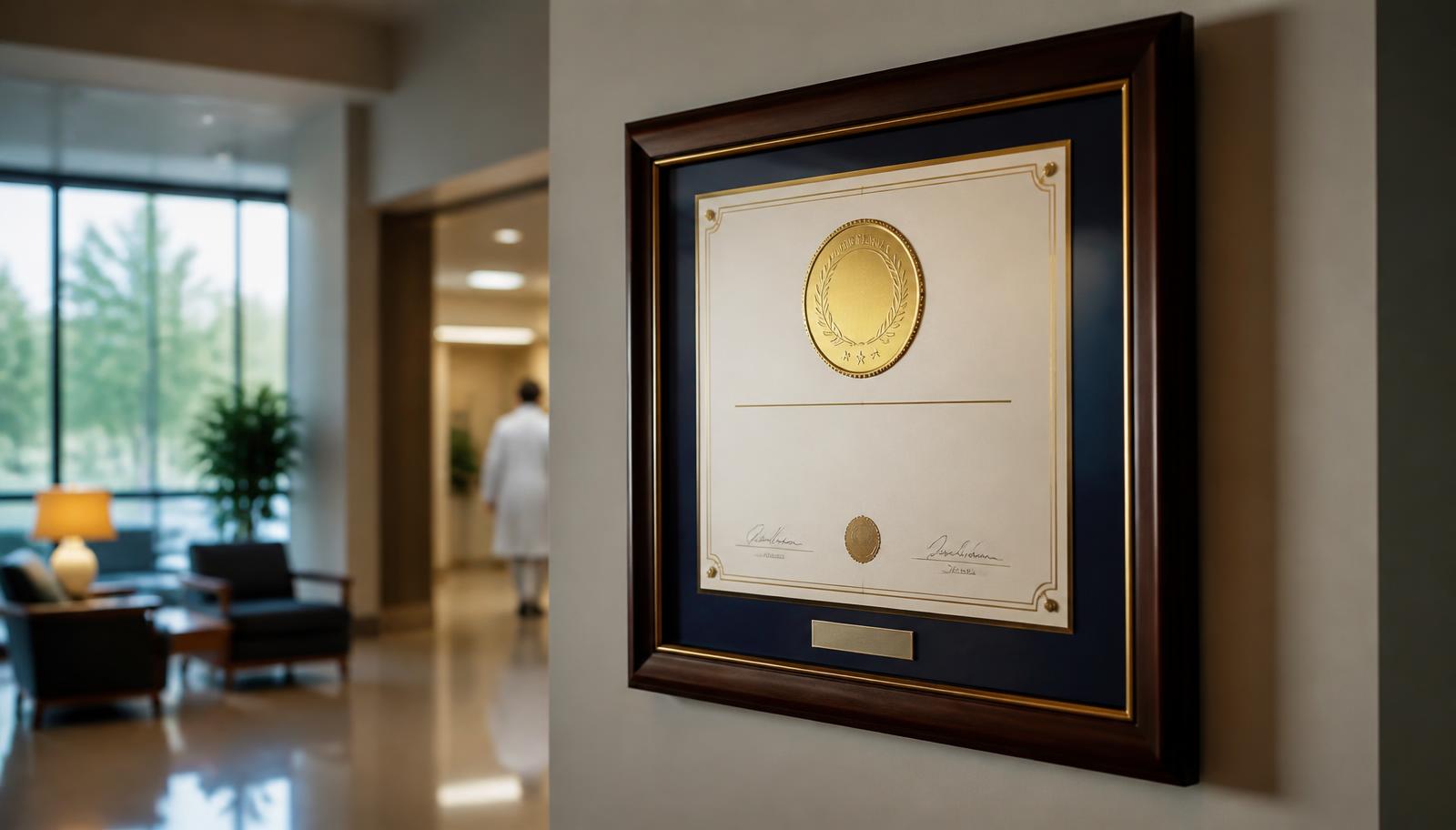
Nearly every treatment center website has a badge somewhere — a small gold seal, a blue "CARF Accredited" logo, sometimes both. Most people scroll past them without knowing what they actually represent. That's understandable. The terms get thrown around constantly, often without explanation, and sometimes as little more than a marketing flourish. But accreditation is a real, specific process with real requirements behind it — and understanding what it actually evaluates says something concrete about how a program operates, not just how it markets itself.
01Accreditation Isn't the Same Thing as a License
Every treatment facility operating in the U.S. needs a state license just to open its doors. Licensing sets a legal floor — the minimum requirements a state considers necessary for a facility to operate at all, covering things like basic safety codes, staff qualifications, and record-keeping.
Accreditation sits above that floor, and it's voluntary. A facility isn't required to pursue it, and plenty of licensed, legitimate programs never do. What accreditation adds is an independent, outside review against a much more detailed set of clinical and operational standards — not just "can this facility legally operate," but "does this facility's actual day-to-day practice hold up against a national benchmark." Two organizations dominate this space in behavioral health: the Joint Commission and CARF International.
02The Joint Commission
The Joint Commission has been accrediting healthcare organizations since the 1950s, and expanded into mental health and addiction services specifically in 1972. Today it accredits more than 4,300 organizations under its Comprehensive Accreditation Manual for Behavioral Health Care. Its accreditation cycle runs three years, and the review isn't a paperwork exercise — it involves an on-site survey examining how a facility actually manages medication, documents informed consent, handles safety protocols, and tracks whether its treatment is working.
In 2019, the Joint Commission specifically enhanced its standards for substance use disorder treatment providers, adding sharper requirements around three things: making sure patients are placed at the level of care that actually matches their needs, ensuring proper follow-up during transitions between levels of care, and governing how drug testing is used clinically rather than punitively. That update matters, because it reflects an accreditor responding directly to how care in this field is supposed to work — not just generic hospital-safety standards applied to a different setting.
03CARF International
CARF — the Commission on Accreditation of Rehabilitation Facilities — has been accrediting organizations since 1966 and has reviewed more than 67,000 programs worldwide. Where the two accreditors genuinely differ is in approach: CARF accredits individual programs rather than entire organizations, uses scheduled rather than surprise surveys, and describes its process as consultative — reviewers are there partly to advise, not only to grade. CARF is also the only accreditor recognized by ASAM specifically for residential substance use disorder certification, and the only body that can certify Certified Community Behavioral Health Clinics against SAMHSA's criteria.
Both accreditors are approved by SAMHSA to certify opioid treatment programs, which are federally required to hold accreditation from one of them in order to legally dispense medications like methadone. That's one of the few places in this entire landscape where accreditation isn't just a voluntary credential — it's a legal precondition for a program to exist at all.
04How Common Is Accreditation, Actually?
Not as common as the badges scattered across treatment center websites might suggest. National survey data from SAMHSA indicates roughly a quarter of U.S. addiction treatment facilities hold Joint Commission accreditation, and somewhere around a third hold CARF accreditation — meaning a substantial share of programs nationally operate on state licensing alone, without either. That doesn't automatically make an unaccredited program worse; plenty of well-run facilities simply haven't pursued the additional review, which involves real cost and administrative work. But it does mean the badge itself is a genuine differentiator, not something nearly every program has.
05What "Dual Diagnosis" Actually Means, Clinically
The term gets used loosely, but it has a specific clinical definition. According to SAMHSA's Treatment Improvement Protocol 42, co-occurring disorders — the clinical term behind "dual diagnosis" — refers to a substance use disorder and a mental health disorder that can each be established independently of the other. That last part matters: it's not simply a cluster of symptoms explained entirely by one condition. Someone whose anxiety only appears during withdrawal, for instance, is a different clinical picture than someone with a diagnosed anxiety disorder that exists whether or not substance use is present.
This distinction shapes how integrated treatment actually works. A program equipped to treat co-occurring disorders isn't just offering a mental health checkbox alongside addiction counseling — it's coordinating both diagnoses within one treatment plan, often with staff cross-trained in both areas, because the research consistently shows that treating only one condition tends to leave the other actively undermining progress.
06Why This Information Matters More Than a Superlative Does
None of this is about identifying a single "best" program — that framing doesn't actually hold up against how differently people's needs vary, and no accreditation badge changes that. What accreditation and clinical terminology like this actually offer is something more useful than a superlative: a way to understand what's actually being claimed when a facility describes itself a certain way, and what independent review — if any — stands behind that description.
Frequently Asked Questions
Is a treatment facility without accreditation automatically lower quality?
Not necessarily. Every operating facility holds a state license, which sets legal minimum requirements. Accreditation is a voluntary additional review, and many well-run programs haven't pursued it, often due to the cost and administrative resources involved rather than any gap in care quality.
What's the actual difference between Joint Commission and CARF accreditation?
Both are legitimate, SAMHSA-recognized accreditors, but they differ in approach. The Joint Commission accredits entire organizations using a more compliance-oriented review with unannounced surveys during its three-year cycle. CARF accredits individual programs using a scheduled, consultative peer-review process, and is the only accreditor ASAM recognizes for residential substance use disorder certification specifically.
Is accreditation ever legally required, or is it always optional?
It's usually voluntary, with one significant exception: opioid treatment programs that dispense medications like methadone are federally required to hold accreditation from a SAMHSA-approved body — either the Joint Commission or CARF — in order to operate legally.
What does "dual diagnosis capable" actually mean, clinically?
It refers to a program equipped to treat co-occurring disorders — a substance use disorder and a mental health disorder that can each be diagnosed independently of one another, per SAMHSA's clinical definition. This is different from a program that only briefly addresses mental health as a secondary concern; integrated treatment coordinates both diagnoses within a single treatment plan.
How common is it for treatment facilities to hold national accreditation?
Less common than many assume. National survey data from SAMHSA indicates roughly a quarter of facilities hold Joint Commission accreditation and about a third hold CARF accreditation, meaning a substantial share of licensed programs operate without either.
---
Sources?
• The Joint Commission, Behavioral Health Care & Human Services Accreditation Program: https://www.jointcommission.org/en-us/accreditation/behavioral-health-care-and-human-services
• The Joint Commission, R3 Report Issue 25: Enhanced Substance Use Disorders Standards for Behavioral Health Organizations: https://www.jointcommission.org/en-us/standards/r3-report/r3-report-25
• CARF International, Opioid Treatment Program Accreditation: https://carf.org/accreditation/programs/opioid-treatment/
• Substance Abuse and Mental Health Services Administration (SAMHSA), TIP 42: Substance Use Disorder Treatment for People With Co-Occurring Disorders, via National Library of Medicine: https://www.ncbi.nlm.nih.gov/books/NBK571020/
• Substance Abuse and Mental Health Services Administration (SAMHSA), National Survey of Substance Abuse Treatment Services (N-SUMHSS) — accreditation prevalence data
Keep reading
More from Treatment Locators

OCD and Addiction: Co-Occurring Treatment and Dual Diagnosis
Obsessive-compulsive disorder and substance use disorder show up together more often than most people expect. Studies of the general population and of people seeking OCD treatment both find that a meaningful share of people with OCD also meet criteria for a substance use disorder.
October 9, 2026

Residential Dual Diagnosis Treatment: Addiction and Mental Health Care in One Setting
Residential dual diagnosis treatment covers addiction and mental health in one live-in setting. Learn how programs differ in psychiatric care and what to ask.
October 8, 2026

Alcohol Detox at Home vs Medical Detox: Risks & Differences
Stopping heavy drinking suddenly on your own can be dangerous, but "at home" and "medical" aren't opposites. Learn how supervised outpatient and inpatient alcohol detox differ, why withdrawal is so hard to predict, and which warning signs call for urgent medical care.
October 6, 2026