
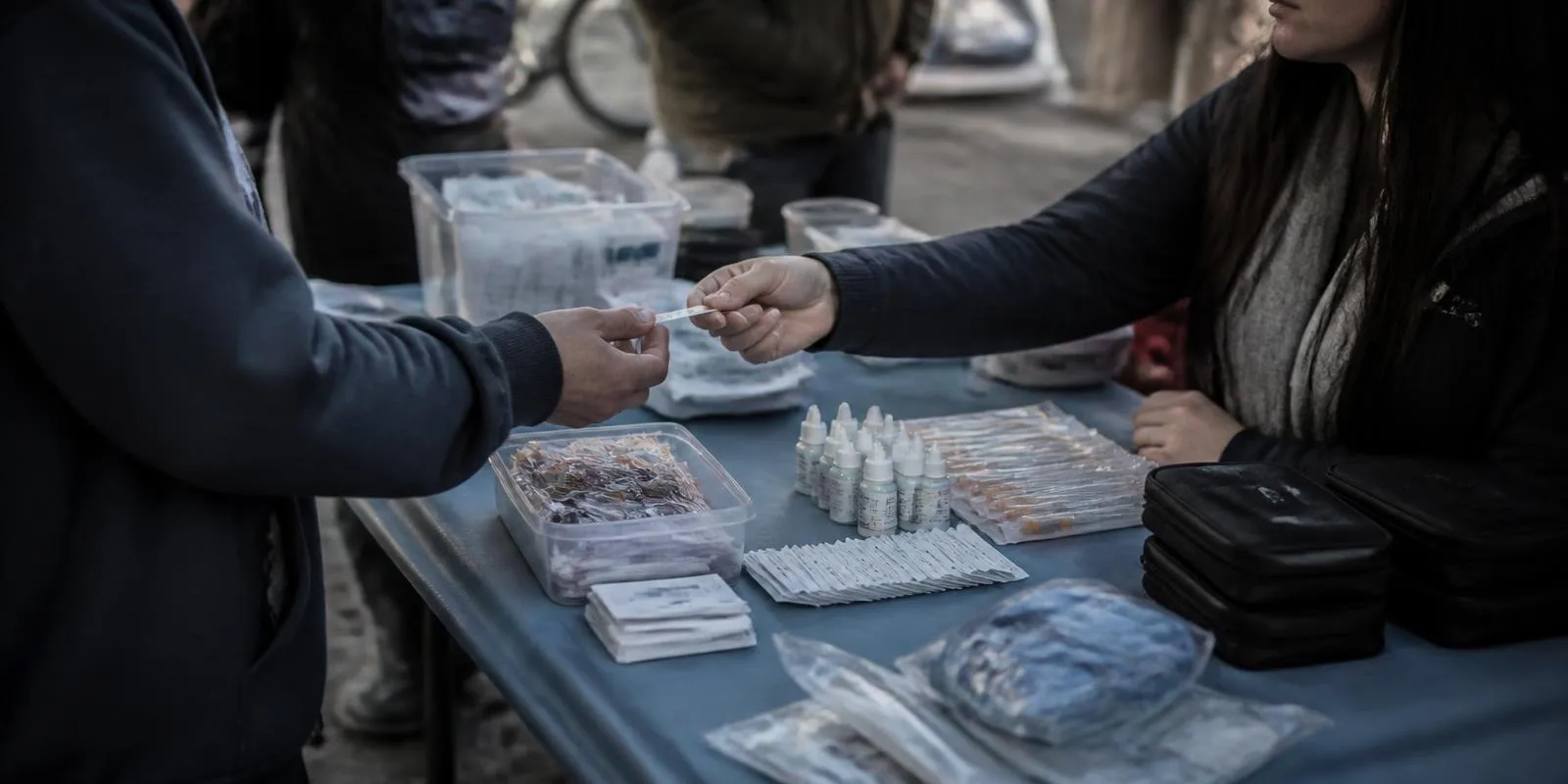
SAMHSA Just Cut Federal Funding for Fentanyl Test Strips and Syringe Programs. Here's What That Actually Changes.
For nearly five years, the federal government treated fentanyl test strips the same way it treated naloxone: a tool it actively funded to keep people who use drugs alive
For nearly five years, the federal government treated fentanyl test strips the same way it treated naloxone: a tool it actively funded to keep people who use drugs alive. As of April 24, 2026, that's no longer true. In a pair of "Dear Colleague" letters, the Substance Abuse and Mental Health Services Administration told grantees that federal funds could no longer pay for fentanyl test strips, sterile syringes, safer-smoking supplies, or overdose hotlines — reversing a position the agency had held since 2021.
This is one of the more consequential — and more contested — federal drug policy shifts in years, and it's already having real, on-the-ground effects on treatment and prevention organizations. Here's what actually changed, why, and what the pushback looks like from the public health and addiction medicine community.
01What the April 2026 guidance actually says
The letters, signed by Principal Deputy Assistant Secretary Christopher Carroll, withdraw federal grant funding eligibility for a specific list of items: fentanyl, xylazine, and medetomidine test strips intended for use by people who use drugs; sterile syringes and needles; pipes and other drug paraphernalia; sterile water and saline for injection; ascorbic acid; safer-smoking supplies; and overdose hotlines that provide remote support to someone while they're using.
The guidance is explicit about the reasoning: it describes the agency's "clear shift away from harm reduction and practices that facilitate illicit drug use and are incompatible with Federal law." A companion letter goes further, encouraging grantees to treat medications for opioid use disorder — methadone and buprenorphine — as a pathway toward abstinence-based recovery rather than as an indefinite treatment option in their own right, a framing that represents a real departure from how most addiction medicine specialists currently understand those medications' role. One carve-out worth noting: the prohibition on test strips and similar testing technology doesn't apply to law enforcement, emergency medical services, public health officials, or healthcare professionals using them in the regular course of their professional duties — the restriction targets distribution directly to people who use drugs, not clinical or first-responder use.
Not everything was cut. The guidance specifically preserves funding for naloxone and nalmefene (both opioid overdose reversal medications), medication lock boxes, sharps disposal, wound care supplies, FDA-approved home testing kits for HIV and viral hepatitis, navigation to HIV prevention medications (PrEP and PEP), and condom distribution. SAMHSA's framing is that these categories represent evidence-based prevention and treatment, while the excluded categories represent what the agency now characterizes as facilitating ongoing illegal drug use.
02Where this policy comes from
This didn't emerge from nowhere. The April 2026 letters build directly on a July 2025 executive order, "Ending Crime and Disorder on America's Streets," which directed the Secretary of Health and Human Services to ensure SAMHSA's discretionary grants support only what the order considers evidence-based programs, and specifically excluded harm reduction or "safe consumption" efforts the administration views as facilitating illegal drug use. SAMHSA's July 2025 guidance was the first step in that shift, and notably, it preserved funding for fentanyl test strips even as it began reframing the agency's overall approach. The April 2026 letters removed that exception.
The 2026 National Drug Control Strategy, released by the Office of National Drug Control Policy, adds a genuinely confusing wrinkle to this picture. That strategy document explicitly states that "rapid test strips and similar technologies that detect fentanyl and other drugs are an important tool that should be legal and not considered drug paraphernalia" — while, simultaneously, SAMHSA's own funding guidance prohibits federal dollars from being used to purchase the same test strips. Faces & Voices of Recovery, a national recovery advocacy organization, flagged this apparent contradiction directly in its policy tracking, noting the organization was seeking clarification on how the two positions square with each other.
There's a second, more precise tension worth understanding: Congress's own appropriations law. Federal appropriations language has, since 2016, barred federal funds from purchasing sterile syringes directly — but with an explicit carve-out: that restriction doesn't apply to other elements of a syringe program if a state or local health department, in consultation with the CDC, determines the jurisdiction is experiencing or at risk of a significant hepatitis or HIV outbreak tied to injection drug use. Under that framework, 45 states currently have an agreement with the CDC permitting exactly this kind of syringe funding during a qualifying outbreak. SAMHSA's April 2026 guidance doesn't override that appropriations language, but recovery advocacy groups have specifically flagged the two as being in tension, warning it could create confusion for grantees and state health officials trying to determine which rule actually governs their situation.
03The evidence base the policy is moving away from
Fentanyl test strip funding wasn't a fringe position before this year — it reflected a fairly broad, if not universal, consensus in public health circles. The CDC has described syringe services programs as safe, effective, and cost-saving, and has maintained since at least 2019 that comprehensive syringe services programs — of which sterile syringe distribution and drug-checking tools like test strips are typically one component — reduce transmission of HIV and hepatitis C without increasing illegal drug use. Independent research reviews have associated syringe service program use with meaningfully lower rates of needle-sharing, and CDC materials note that people who use syringe services programs are substantially more likely to enter substance use disorder treatment than people who don't.
The CDC and SAMHSA had specifically authorized federal funds for fentanyl test strip distribution starting in 2021, treating drug-checking as an evidence-based harm reduction strategy in its own right — a position STAT News noted the April 2026 guidance directly reverses. The concern from public health researchers isn't hypothetical: fentanyl contamination in the illicit drug supply, often in drugs a person doesn't expect to contain it, has been one of the primary drivers of overdose deaths over the past several years, and test strips are one of the few tools that let someone check what they're about to use before using it.
04What this looks like on the ground
The abstract policy change becomes concrete fast at the program level. One example that's been reported in detail: a harm reduction organization in Kentucky learned it would lose a $400,000 federal grant that had funded distribution of 48,465 fentanyl test strips in the first quarter of 2026 alone — a single grant, in a single state, covering tens of thousands of individual testing opportunities. Programs in that position face an immediate choice between absorbing the cost from other funding sources, scaling back distribution, or stopping it altogether, with little lead time to adjust.
This arrives on top of funding instability that predates the April guidance. Before the harm reduction-specific letters were issued, SAMHSA had already cancelled roughly $1.7 billion in block grant funding and cut a further $350 million specifically targeted at addiction and overdose prevention programs, according to reporting on the agency's broader funding trajectory. Combined with the leadership vacancy and staffing reductions described above, organizations that depend on SAMHSA funding have had to plan around a level of year-to-year uncertainty that's unusual even by the standards of federal grant-making, where funding levels can shift with changes in administration but rarely this abruptly within a single budget cycle.
05Why drug-checking specifically drew federal support in the first place
It's worth understanding why fentanyl test strips became federally funded to begin with, since that context is largely what's being reversed. Illicit fentanyl's potency varies enormously from batch to batch, and it's frequently present in supplies of other drugs — counterfeit prescription pills, cocaine, and methamphetamine among them — without the person buying them necessarily knowing it's there. Test strips let someone check a substance before using it, without requiring them to stop using altogether, which is precisely the "meet people where they are" logic that distinguishes harm reduction from abstinence-focused approaches. The CDC's decision to authorize federal funding for test strips in 2021 reflected a judgment that this kind of drug-checking reduced fatal overdoses without meaningfully increasing overall drug use — a research finding, not simply a philosophical stance. The April 2026 guidance doesn't dispute that specific research; instead, it recategorizes drug-checking as facilitating illicit use regardless of its downstream safety effect, which is the crux of the disagreement between the current policy and the organizations opposing it.
06What critics are saying
The pushback has come from multiple directions. Writing in Health Affairs Forefront, public health researchers argued the new requirements "risk jeopardizing US lives" by deemphasizing medications for opioid use disorder and withdrawing support for fentanyl test strips and syringe services — services they characterize as evidence-based rather than merely tolerated. Their core argument is one of internal inconsistency: the same federal drug strategy that says the goal is "making treatment more accessible than drugs" is, in their reading, simultaneously making some of the most evidence-supported tools for keeping people alive long enough to reach treatment harder to access.
The concern about the MOUD-related language is a distinct thread worth understanding on its own terms. Methadone and buprenorphine are the two medications with the strongest evidence base for reducing opioid overdose death, and current clinical guidance from organizations like the American Society of Addiction Medicine generally treats duration of treatment as a decision between a patient and their provider, not a fixed timeline — many patients benefit from indefinite, ongoing medication, the same way someone with another chronic condition might take a maintenance medication indefinitely rather than "graduating" off it. A federal funding posture that nudges providers toward treating these medications as short-term bridges runs against that clinical framework, which is the basis of the Health Affairs critique specifically.
There's also a broader instability context worth understanding. As of this policy shift, SAMHSA had gone more than fifteen months without a permanent, Senate-confirmed director, and agency staffing had fallen from roughly 900 employees to less than half that number. In January 2026, the administration briefly moved to terminate close to $2 billion in SAMHSA discretionary grants — funding that was restored within 24 hours after congressional pushback, according to policy trackers following the episode closely. That volatility means the harm reduction funding change hasn't landed as an isolated, carefully sequenced policy — it's arrived alongside genuine uncertainty about the agency's operational capacity more broadly.
07The administration's stated rationale
It's worth representing the other side of this fairly. The policy's defenders frame it as a matter of aligning federal spending with a treatment-and-recovery-first philosophy rather than what they characterize as a framework that normalizes ongoing illicit drug use. The underlying executive order frames harm reduction distribution of drug paraphernalia as incompatible with federal law — a reference to the fact that, under some readings of existing statute, distributing certain drug-use equipment sits in legally ambiguous territory regardless of its public health rationale. SAMHSA's guidance frames the shift as directing resources toward what it considers the categories most clearly tied to treatment and long-term recovery, rather than toward supplies intended for continued drug use, however safely.
The administration has also paired this shift with initiatives explicitly framed around expanding treatment access, including the broader Great American Recovery Initiative launched the same month as the July 2025 executive order's implementing guidance. Whether the net effect of the combined policy shifts increases or decreases overall access to effective care is genuinely contested, and reasonable people, including people working directly in addiction medicine, disagree on the answer.
08What this means in practice for treatment and prevention organizations
For organizations that had built federal grant funding into their harm reduction programming, this is not an abstract policy debate — it's an immediate operational problem. Programs that relied on SAMHSA grants to purchase fentanyl test strips, at roughly a dollar each, or to fund syringe distribution, now need to find alternative funding sources or scale back those specific services, even if the rest of their programming, including naloxone distribution and treatment referrals, continues to qualify for federal support.
For people using drugs and the organizations that serve them, the practical effect is likely to be uneven rather than uniform. States and localities with independent, non-federal funding streams for harm reduction, or those that have built philanthropic or state-level support, will be affected less than programs that depended primarily on federal dollars. Because SAMHSA funding conditions can now shift a program's available supply list without any accompanying change in state law or local ordinances, service availability in a given community may fluctuate in ways that have little to do with what's locally legal or locally supported.
For addiction treatment providers more specifically — including facilities and directories in the treatment-search space — the more consequential piece to watch is the MOUD-related messaging, since that one touches how opioid use disorder treatment itself gets framed and funded, not just adjacent prevention services. If federal grant guidance increasingly favors framing methadone and buprenorphine as short-term measures, that has the potential to influence how some programs describe or structure their own medication protocols, independent of what the clinical evidence supports.
09The bottom line
This is a live, unresolved area of federal policy, not a settled one. The 7-OH scheduling story covered elsewhere in this section shows regulators moving cautiously, in stages, specifically because of past public backlash. This harm reduction funding shift has moved faster and drawn similarly organized opposition — from Health Affairs contributors, from recovery advocacy organizations, and from state and local programs directly affected. Whether the policy holds, gets modified, or gets challenged in the same way SAMHSA's January 2026 grant terminations were reversed within a day, is very much still being determined.
Frequently asked questions
Did the federal government ban fentanyl test strips?
No. Fentanyl test strips remain legal to buy, sell, and possess in most states. What changed is that SAMHSA grant funding can no longer be used to purchase them for distribution — a funding decision, not a criminal law change. Some states have their own paraphernalia laws that separately affect test strip legality regardless of federal funding rules.
Does this affect naloxone availability?
No. Naloxone and nalmefene, the medications used to reverse an opioid overdose, are explicitly preserved under the April 2026 guidance and remain a funding priority. This policy change specifically targets a different category of harm reduction supplies — testing and injection equipment — not overdose-reversal medication.
Why did SAMHSA change its position on test strips specifically, after funding them since 2021?
The April 2026 guidance builds on a July 2025 executive order directing the agency away from harm reduction funding broadly. Notably, the July 2025 guidance had initially preserved test strip funding even while shifting other harm reduction funding; the April 2026 letters removed that specific carve-out, closing the gap between test strips and other now-excluded supplies like syringes.
Is this the final word on the policy, or could it change again?
It's genuinely unresolved. SAMHSA has shown volatility on funding decisions recently — a January 2026 attempt to terminate roughly $2 billion in discretionary grants was reversed within 24 hours after congressional pushback. There's also an unresolved tension between this SAMHSA guidance and language in the 2026 National Drug Control Strategy describing test strips as something that "should be legal and not considered drug paraphernalia," which recovery advocacy groups have flagged and are seeking clarification on.
Does this change how methadone or buprenorphine treatment works?
Not directly or immediately — this is funding guidance, not a change to clinical practice standards or FDA-approved treatment protocols. But the companion guidance's framing, which encourages viewing these medications as a pathway to abstinence rather than an open-ended treatment option, represents a shift from how many addiction medicine specialists currently approach treatment duration, and could influence how federally-funded programs structure their own protocols over time.
---
Keep reading
More from Treatment Locators

How to Get Someone Into Rehab: What Families Can Do When a Loved One Needs Treatment
Watching someone you love struggle with addiction while they insist nothing is wrong is one of the more disorienting positions a family member can be in. You can see the problem clearly. They may not see it at all, or they see it and aren't ready to act on it.
September 15, 2026

How Much Does Inpatient Rehab Cost With Private Insurance?
The most rigorous available data on what insured people actually pay comes from a Peterson-KFF Health System Tracker analysis of 2023 commercial insurance claims.
September 14, 2026

Same-Day Rehab Admissions: How Immediate Addiction Treatment Access Works
Learn how same-day rehab admissions work, including detox, residential treatment, insurance, assessments, bed availability, and levels of care.
September 13, 2026